
'We are cautious only on sub-sectors that have seen massive melt-up during the past six months.'

On December 16, 2015, the apex court ordered disclosure of the defaulters' list, and upheld a Central Information Commission order to this effect.
Rush to offload bad loans indicates a revival in asset-sale market

From the roll-out of GST to H1B visa problems, the government needs to quickly deal with various disruptions.

'We have a plan to plough back a 'This year in the first half we had profits of more than Rs 31,000 crore.' significant amount of profits this financial year.' 'We have seen this organic plough back of profit is one of best ways to support the equity of the bank.'

The meeting will be attended by all heads and EDs of public sector banks

With over Rs 15,000 crore in deposits, its strategy is a hit for now, but the real test will come when it starts lending to retail and corporate customers in a big way

The bank had reported a net profit of Rs 2,325.70 crore in last FY.

Rajnish Kumar was on Wednesday appointed the new chairman of the largest public sector bank, State Bank of India (SBI), replacing Arundhati Bhattacharya who completes her one-year extended term on Friday.

An improvement in political relations, anchored in a restoration of peace and tranquillity at the border, could open up opportunities for expanded economic and commercial relations between them, suggests former foreign secretary Ambassador Shyam Saran.

'When bankers are hounded by investigative agencies for credit decisions going wrong and defaulters are treated like outcasts, who will borrow money and who will lend?' asks Tamal Bandyopadhyay.

The country's narrowing power deficit and increased coal production may not be indicators of the end of stress in the industry. Amritha Pillay reports.
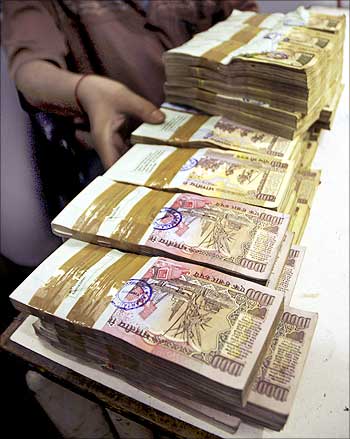
Bad loans in public sector banks more than tripled.

Banks have been struggling hard to recover dues from grounded Kingfisher Air.
The Reserve Bank of India (RBI) has offered some leeway to banks for early detection and resolution of bad loans. Under the new regime kicking off from April 1, lenders can finance 50 per cent of the outstanding loan value, RBI said in Framework for Revitalising Distressed Assets in the Economy, released on Thursday.

If the earnings in the first quarter of the current financial year are an indication, most banks, particularly those majority-owned by the government, have fared well, reveals Tamal Bandyopadhyay.
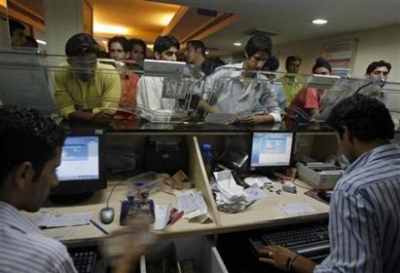
Private banks are assumed to be more efficient at intermediating between depositors and investors.

DDinesh Kumar Khara is someone who cares for others's ideas and suggestions.
If he takes the people along with him (which he always does); cares for the customers (80 per cent of SBI's new customers are in the 20-40 age group); and doesn't take his eyes off technology, his job is done, says Tamal Bandyopadhyay.

Bankers seem to be pleased with the government for keeping its promise of not interfering in operational matters, but are apprehensive about the intense scrutiny of their functioning.

Collectively, the pack of 12 has posted a 50 per cent rise in profits -- Rs 25,685 crore. On a quarter-on-quarter basis (that is, September over June), the rise is 68 per cent. Public sector banks have never had such a stellar performance, explains Tamal Bandyopadhyay.

Public sector banks' need for capital should be used to make fundamental reforms to their governance and management.

ICICI Bank puts up a good show in Q4.

The Reserve Bank of India collects credit information from banks under the CRILC reporting system for borrowers with the credit exposure greater than Rs 5 crore.

Under the new model, the surplus distribution in the participating policyholders' fund has been modified to 90:10 in a phased manner, wherein 90 per cent will go to policyholders and 10 per cent to shareholders. Further, 100 per cent of the surplus generated out of the non-participating business will be available for distribution to all shareholders.

'Our stable outlook currently points to the fact that the ratings are likely to remain stable for the next couple of years.'

For development finance institution to succeed now, the government must stand like a rock behind it and be patient.

Banks cannot shirk their responsibility in cases of frauds.

India's equity markets are on a roller-coaster ride, after delivering spectacular returns for two consecutive years - in 2020 and 2021. The benchmark National Stock Exchange's (NSE's) Nifty50 is down 1.5 per cent in the first nine months of the current calendar year 2022 (CY22) as foreign portfolio investors sold Indian stocks due to rising bond yields in the US and across global markets, including India. The sell-off in the Indian equity markets has, however, not been broad-based and largely limited to sectors facing earnings headwinds from rising interest rates, lower commodity and energy prices, and likely economic recession in advanced economies.
.jpg)
The Reserve Bank on Monday warned lenders against outsourcing their credit processing activities to third-party entities.

Sensex closed over 118 points down on Thursday.

RBI has cited at least 10 areas where it has no control over PSBs.

The decision in this regard, however, is expected to be taken by the new government.

On November 12, 2021, the Reserve Bank of India (RBI) decided to ring in uniformity in asset classification and income recognition across all lending institutions. Shadow banks, or non-banking financial companies (NBFCs), like commercial banks, are to test non-performing assets (NPAs) on a daily basis and upgrade them to "standard assets" only when interest and principal arrears are settled by borrowers. This is going to create all manner of headaches for shadow banks and their clientele. Says Y S Chakravarti, managing director and chief executive officer (CEO), Shriram City Union Finance: "NPA levels will go up, especially of small borrowers.

Moody's expects macroeconomic policies to contribute to sustained robust growth.

The amount of loans that carry a high risk of slippage into the NPA category over the next few quarters is about Rs 2.8 trillion.

The Union finance ministry is planning to make rules regarding wilful defaulters more stringent, so that criminal charges can be pressed against such entities.

the three investors that have submitted their final bids are not commercial banks. Among the three, one is a non-banking financial company. Another distinctive feature of the revival is that PMC may lose its cooperative bank characteristic after its reconstruction.

Consensus continues to be cautious with analysts pointing towards tougher days ahead

Jaitley said the total gross NPA ratio has gone up to 4.03 per cent in 2013-14 from 3.42 per cent in 2012-13 and 2.94 per cent in 2011-12.

Why are investors gung-ho about State Bank? asks Tamal Bandyopadhyay.
